

REVIEW · 7-DAY EXPERIENCES
7 Days Private Guided Tour in Romania from Bucharest
Seven days, and Romania starts to feel personal. This private guided route links medieval castles with fortified churches, Orthodox spirituality, and big-name nature stops, all paced by a licensed English-speaking guide in your own car. I especially like the way the experience feels personal, with guides such as Nicolas and Andrei noted for making the week run smoothly, from pickup to the day-to-day details.
I also like the flexibility built into the plan, so you are not trapped in a rigid schedule once you are already there. One possible drawback to think about up front: entrance fees are not included (some sights are free, many are not), and at least one stop includes a tough climb with 1480 stairs at Poenari. If you plan footwear and a realistic effort level, it is a great fit.
In This Review
- Key highlights you will actually care about
- Why This 7-Day Romania Route Works From Bucharest
- Price and Value: What You Get for About $2,480 Per Person
- Day 1: Peles Castle, Sinaia Monastery, and Brasov at Nightfall
- Peles Castle, royal details without the effort
- Sinaia Monastery, a short breath of Orthodox spirituality
- Brasov historical center, easy walking and big atmosphere
- Day 2: Bran Castle and Sighisoara, where Dracula meets medieval reality
- Bran Castle, Dracula vibes plus myth-versus-history
- Sighisoara citadel, a medieval town that stayed alive
- Clock Tower, quick climb, strong views
- Viscri village, fortified church and countryside calm
- Day 3: Sibiu’s Grand Square and the Cathedral Mix of Central Europe
- Piata Mare (Large Square), Renaissance geometry in motion
- Orthodox Cathedral of the Holy Trinity, a Byzantine-style look
- Lutheran Evangelical Cathedral and Tower, classic Central European form
- Biertan fortified church, a UNESCO-listed church-fortress system
- Day 4: Densus Church, Corvin Castle, and Bigar Waterfall Reset
- Densus Church, layered centuries in one “old temple”
- Castelul Corvinilor, gothic knights without the costume
- Bigar Cascade, a short visit that feels like a breather
- Day 5: Iron Gates, Decebalus, and Roman ruins at the Danube
- Iron Gates, engineering drama in the Danube Gorge area
- Statue of King Decebalus, 128 meters of carved memory
- Castrul Roman Drobeta, Roman leftovers at the mouth of the Danube
- Day 6: Brancusi’s sculptures in Targu Jiu and UNESCO at Horezu
- Table of Silence and the Sculpture Ensemble
- Gate of the Kiss, a short stop with a clear idea
- Infinity Column, the “endless” effect
- Horezu Monastery, authentic Romanian architecture and UNESCO
- Polovragi Cave, a Carpathian foothills add-on
- Day 7: Poenari’s Stairs, Vidraru Dam, and Curtea de Arges Monastery
- Poenari Castle, 860 meters and 1480 stairs
- Vidraru Dam, a quick photo stop with real scale
- Curtea de Arges Monastery and Cathedral, early 1500s stone and fresco interior
- Practical Notes: Tickets, Timing, and How to Avoid the Usual Headaches
- Entrance fees: plan for them
- Meals and drinks: go with your guide’s pacing
- Shoes and stamina matter
- Who This Tour Suits Best (and who should reconsider)
- Should You Book This 7-Day Private Guided Tour?
- FAQ
- Is this a private tour for my group only?
- Does the tour include pickup?
- What language is the guide?
- Is Wi-Fi included?
- Are entrance fees included?
- What about accommodation and meals?
- What is included in the car cost?
- How long is the tour?
Key highlights you will actually care about
- Private car for your group, with a dedicated English-speaking guide/driver and in-car wireless internet
- Castle legends grounded in real places, from Bran’s Dracula myth to Poenari’s Vlad the Impaler connection
- Fortified churches and UNESCO-worthy sites, including Biertan and Horezu
- Nature days that feel planned, not improvised, with stops like the Iron Gates area and Bigar waterfall
- Budget-friendly moments built in, with multiple planned stops marked free on the itinerary
- Guides praised for service, including Nicolas and Andrei, plus smooth pickup and on-the-go support
Why This 7-Day Romania Route Works From Bucharest

This is the kind of tour that makes sense if you want variety without the mental load of planning every turn. You start in Bucharest, then work your way through Transylvania style towns and castles, before shifting into churches, valleys, and nature heavy hitters in the later days.
What makes it feel efficient is the balance: you get the famous postcard moments, but they are threaded together with a bigger story about how people lived, fought, prayed, and built for centuries. You do not just look at buildings, you learn why they mattered and how they connect.
Also, because it is private, you are not stuck waiting for a big group to finish a museum or decide where to eat. If you move at a slower pace, the guide can often steer the day so you still hit the important stops.
A few more Bucharest trips worth weighing up
- Castles of Transylvania: Private Day Trip from Bucharest
★ 4.5 · 248 reviews - Bucharest: Best of Bucharest Private Tuk-Tuk Tour
★ 5.0 · 238 reviews - Dracula’s Castle, Peles Castle and Brasov – Private Day Trip from Bucharest
★ 5.0 · 211 reviews
Price and Value: What You Get for About $2,480 Per Person
At $2,480.58 per person for a 7-day private tour, the headline price sounds high until you break down what is included. This is not just someone dropping you off at sights.
Your package includes:
- A private car (tourism car or minibus) just for your group
- A private, licensed English-speaking guide/driver available through the tour
- Accommodation, meals, and entrance fees for the guide (so the guide is not juggling logistics while you sightsee)
- All car expenses such as gasoline, parking, and road tolls
- Wireless internet in the car
- A flexible setup that allows changes to the itinerary even after the tour starts
What is not included is the big cost variable for many visitors:
- Your accommodation, meals, and most entrance fees as listed per stop
The practical takeaway: you are paying for time, comfort, and context. In Romania, where distances are real and the roads can be tiring, that dedicated transport and a guide who can explain what you are seeing is often the difference between a “sight list” trip and a trip that actually sticks in your memory.
If you are the type who hates figuring out tickets, opening hours, and where to stand for the best views, this kind of private setup can feel like good value.
Day 1: Peles Castle, Sinaia Monastery, and Brasov at Nightfall
Day 1 sets a romantic tone right away.
Peles Castle, royal details without the effort
Peles Castle is the kind of place you can spend hours inside, and the itinerary gives you about 2 hours here. Admission is not included, so budget for the entry ticket.
What I like about starting here is the clarity. You see why Romanian royalty mattered and why this summer residence became a magnet for visitors. Even if you only care about the exterior, it is one of the stops where the photos look better when you actually stand near the details.
A different sort of day out in Romania:
- Bucharest: Dracula’s Castle, Peles Castle, & Brasov Old Town
★ 4.5 · 17,858 reviews - Bucharest: Dracula Castle, Peles Castle & Brasov Old Town
★ 4.6 · 10,891 reviews - Bucharest: Dracula’s Castle, Peleș Castle & Brașov Day Trip
★ 4.4 · 6,100 reviews - Bucharest: Palace of Parliament Tickets and Guide
★ 4.3 · 3,182 reviews
Sinaia Monastery, a short breath of Orthodox spirituality
Next is Manastirea Sinaia, around 30 minutes. Admission is not included.
This is not a “run through and out” stop. It is a pause. You get a taste of Orthodox spirituality and the simplicity and richness expressed in the monastery’s artistic representations. If you want quieter moments between big castle days, this is a good anchor.
Brasov historical center, easy walking and big atmosphere
Brasov’s historical center is a strong way to finish the day, with about 2 hours and admission ticket free listed for this portion.
I like this as an ending because you can slow down, wander, and absorb the medieval-meets-mountain feel. You are not rushing to another ticketed location immediately. Brasov works especially well if you enjoy strolling around old streets and looking at how towns defend themselves in stone, not marketing copy.
Day 2: Bran Castle and Sighisoara, where Dracula meets medieval reality
Day 2 is built for people who like legends, but also like when myths have roots.
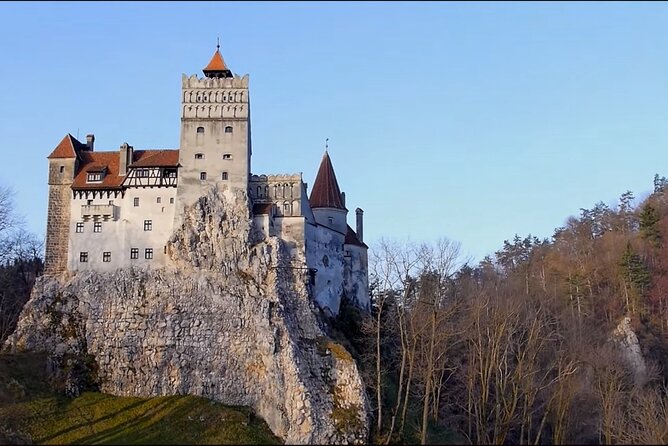
Bran Castle, Dracula vibes plus myth-versus-history
Bran Castle is about 2 hours, and admission is not included. The itinerary frames it as the Dracula castle that sits between myth and history, and you will hear how its resemblance to Bram Stoker’s fictional Dracula led to the famous association.
One smart way to enjoy Bran is to plan time outside as well. The itinerary suggests trying Romanian classics nearby, including handmade cheeses, pálinka (plum and pear brandy), and traditionally-produced ham and sausages. Since meals are not included in your package, this is a place where your guide can help you choose wisely without wasting time on menus.
Sighisoara citadel, a medieval town that stayed alive
Then comes Sighisoara Citadel, about 2 hours. Admission is not included.
This is one of the most interesting “how is this still here?” moments of the whole trip. The citadel is described as dating back to the 12th century, and it is still inhabited for over 700 years. That is rare. You are not just viewing a preserved set, you are looking at a living town structure where the medieval layout still shapes daily life.
Clock Tower, quick climb, strong views
The Sighişoara Clock Tower is a short 30-minute stop with admission not included.
It is worth using your time smartly: spend enough time for the panorama and only as much time inside as you feel like. The description points out a museum inside with a patchy collection of items and an English-language explanation that can vary, so if you care less about artifacts, prioritize the view.
Viscri village, fortified church and countryside calm
Finally, Village de Viscri for about 1 hour 30 minutes, with admission ticket free listed.
Viscri is known for its fortified church and for revitalization helped by the Mihai Eminescu Trust, plus the attention it gained through visits by Prince Charles. If you like villages where time seems slower, this is one of those stops. It also adds a Transylvania layer beyond the castles, which keeps the week from repeating the same visual theme.
Day 3: Sibiu’s Grand Square and the Cathedral Mix of Central Europe

Day 3 keeps you in Transylvania’s cultural lane, centered on Sibiu.
Piata Mare (Large Square), Renaissance geometry in motion
Piata Mare is about 1 hour, free of admission.
I like beginning Sibiu here because it gives you orientation. The square opens a wide perspective typical of the Renaissance and later ages, and the itinerary notes it began as a grain market and became the citadel center by the 16th century. Even if you do not catch every date, you feel the order of the place.
Orthodox Cathedral of the Holy Trinity, a Byzantine-style look
The Catedrala Ortodoxa Sfanta Treime is about 30 minutes, admission not included.
This is described as a smaller-scale copy of the Sofia Cathedral in Constantinople. The detail that it looks more like a Byzantine basilica helps set expectations. If you like how religious architecture signals identity through style, this is a strong stop.
Lutheran Evangelical Cathedral and Tower, classic Central European form
Next is Lutheran Evangelical Cathedral & Tower, about 45 minutes, with admission free listed.
Tower time is usually where I decide if a day is a quick hit or a meaningful day. If you are the view type, prioritize the tower portion and get your bearings from above before you move on.
Biertan fortified church, a UNESCO-listed church-fortress system
Then: Biertan Fortified Church, about 1 hour, admission not included.
This is where your tour’s theme shifts from pretty towns to defense architecture. The church was built by the ethnic German Transylvanian Saxon community and tied to the Kingdom of Hungary period. It became Lutheran after the Reformation, and the surrounding villages plus the fortified church are part of the UNESCO World Heritage site covering Transylvanian fortified churches.
If you like understanding why walls matter, this stop will land well. If you do not, at least spend time outside too. Fortified churches are meant for a community, not just a building.
Day 4: Densus Church, Corvin Castle, and Bigar Waterfall Reset
Day 4 is a strong mix of ancient layers, gothic drama, and nature therapy.
Densus Church, layered centuries in one “old temple”
Densus Church is about 30 minutes, admission not included.
The itinerary describes it as among the oldest Orthodox churches in Romania, built on top of ruins dating back to the 4th century, with final changes in the 13th century. You also get mural paintings dating back to 1443.
This is the kind of stop where a guide makes a difference. You can look at stone and guess, or you can learn how different time periods are stacked together.
Castelul Corvinilor, gothic knights without the costume
Corvin or Hunyadi Castle is around 2 hours, admission not included.
It is described as one of the top 10 most beautiful gothic castles in the world and as one of the largest castles in Europe, plus one of the seven wonders of Romania. After a fire, it underwent extensive restoration and is now open as a museum.
If you want a practical photo tip, the itinerary even suggests the defense towers for selfies. I would treat that as a time-saving cue: take your photos at the towers, then focus on the museum portion if you genuinely enjoy gothic interiors.
Bigar Cascade, a short visit that feels like a breather
Finally, Bigar Cascade Falls for about 30 minutes, admission free listed.
This is the reset button of the day. The itinerary uses Eden-style imagery, but what matters to you is that it is a nature stop with fresh air and mossy rocks where the water creates a veiling effect. It is short, so it works even if you are tired after castle time.
Wear shoes you can trust on uneven paths. Water stops can be slick, even when the stroll looks easy.
Day 5: Iron Gates, Decebalus, and Roman ruins at the Danube
Day 5 is about big scale and geology.
Iron Gates, engineering drama in the Danube Gorge area
Iron Gates is about 1 hour, admission free listed.
The itinerary frames it around a daring engineering work begun in the communist era in 1960. Even if you only skim the history part, the Danube here feels like a force, not just a river.
This is also a good day for simply standing in one spot and watching how water behaves in tight spaces. When you have a guide, you can get the “what you are seeing” explanation instead of guessing.
Statue of King Decebalus, 128 meters of carved memory
Next is the Statue of King Decebalus, about 45 minutes, admission free listed.
The description says the monument is carved into a cliff face 128 meters above the Danube, near Orsova and the Kazan Gorge. It also notes the statue took 10 years to build. The itinerary adds that scientists uncovered some of the earliest traces of human life in the area.
I like this stop because it turns geography into history. You are looking at a monument, but the real story is what the river corridor protected and attracted for thousands of years.
Castrul Roman Drobeta, Roman leftovers at the mouth of the Danube
Last stop of the day is Castrul Roman Drobeta, about 1 hour, admission free listed.
You get Roman ruins at the mouth of the Danube, including an ancient Roman bridge. If you like history that feels physical, this is a good way to end the day after the massive river gorge atmosphere.
Day 6: Brancusi’s sculptures in Targu Jiu and UNESCO at Horezu
Day 6 gives you art and faith on the same schedule.
Table of Silence and the Sculpture Ensemble
You start with Table of Silence in Targu Jiu, about 20 minutes, free.
The ensemble is described as four sculptures laid out on a 1275 m axis, including the Table of Silence, Chairs Alley, Gate of the Kiss, and the Infinity Column. Even if you are not an art person, I find it calming. The shapes are simple, but the symbolism is the point.
Gate of the Kiss, a short stop with a clear idea
Then Gate of the Kiss, about 20 minutes, free.
This is part of the same Brancusi ensemble and described as a symbol of Romanian spirit. It is quick, so if you have limited time in a day, it still feels like you got the essentials.
Infinity Column, the “endless” effect
Then Infinity Column, about 30 minutes, free.
Again, it is one of those stops where you might appreciate it more after you understand it is part of an axis plan, not just one random sculpture.
Horezu Monastery, authentic Romanian architecture and UNESCO
Next is Horezu Monastery (Hurezi Monastery) for about 30 minutes, and admission is listed as free.
This is UNESCO World Heritage and described as one of the most beautiful and refined Orthodox monasteries, with 100% authentic Romanian architecture from the very beginning. It also connects to Horezu ceramics and gorges carved in mountain walls, plus stone caves.
If you like seeing craftsmanship instead of just seeing old walls, this is one of the most satisfying stops of the week.
Polovragi Cave, a Carpathian foothills add-on
Finally, Polovragi Cave, about 1 hour, admission not included.
It is located at the foothills of the Carpathian Mountains in the Oltet Gorges, not far from Transalpina. Since it is ticketed, plan for the entry fee and bring a light layer if the cave area is cooler.
Day 7: Poenari’s Stairs, Vidraru Dam, and Curtea de Arges Monastery
Day 7 is where you earn your views.
Poenari Castle, 860 meters and 1480 stairs
Poienari Castle is listed as about 2 hours, admission not included.
This is a ruined fortress about 860 meters up, tied to Vlad the Impaler. The itinerary points out the real challenge: you climb 1480 stairs to reach it.
Here is my practical advice: go at your own pace, take breaks, and do not start running up in “vacation fitness mode.” The physical effort is part of the experience, but you want the view to feel like a reward, not punishment.
Vidraru Dam, a quick photo stop with real scale
Next is Vidraru Dam for about 15 minutes, admission free.
The facts in the itinerary help you size it up: completed in 1966, arch dam height 166 meters, arch length 305 meters, and it creates Lake Vidraru. If you like big infrastructure, this hits. If you just want photos, 15 minutes is probably enough.
Curtea de Arges Monastery and Cathedral, early 1500s stone and fresco interior
Finally: Curtea de Arges Monastery and Cathedral, about 45 minutes, admission not included.
The cathedral is early 16th century, Orthodox, dedicated to the Dormition of the Mother of God, and faced with pale grey limestone. The interior is brick, plastered, and decorated with frescoes, and the Royal Palace nearby is late 19th century.
This is a nice concluding stop because it brings you back to architecture with a clear timeline, from older Orthodox tradition to later royal-era framing.
Practical Notes: Tickets, Timing, and How to Avoid the Usual Headaches
A private tour does not remove every expense or every choice, but it does reduce the stress.
Entrance fees: plan for them
Admission fees are explicitly not included for many major stops, including Peles Castle, Bran Castle, Sighisoara sights, and several monasteries or churches. Some stops are listed as free (like Brasov historical center, certain square and sculpture ensemble portions, and multiple Danube viewpoints). So you will likely mix ticketed and free admissions across the week.
My suggestion: ask your guide early which tickets you should expect for your group and then budget accordingly, so you do not get surprised on the spot.
Meals and drinks: go with your guide’s pacing
Food and drinks are not included, which is normal for private tours. The itinerary even hints that you might try Romanian specialties near Bran, including cheeses and pálinka.
If you like eating where local people eat, your guide can often help you pick places that match your pace and avoid long detours.
Shoes and stamina matter
This tour includes a serious climb at Poenari (1480 stairs) and multiple churches and castle sections where you will likely walk on uneven ground. You do not need to be an athlete, but you should come with solid shoes and a realistic effort level.
Who This Tour Suits Best (and who should reconsider)
This is a great match if:
- You want a private Romania week with an English-speaking licensed guide driving and explaining
- You like history that connects buildings to real life, not just photos
- You want a balance of castles, fortified churches, Orthodox sites, and nature scale
- You appreciate flexibility, not a rigid, hour-by-hour script
You might reconsider if:
- You hate stairs or have limited mobility, especially for Poenari
- You want everything fully included, since accommodation, meals, and many entrance fees are not included
- You dislike long driving days. This itinerary packs multiple regions into a single week, so time on the road is part of the deal
Should You Book This 7-Day Private Guided Tour?
I would book it if you want Romania with structure, comfort, and context. The big strengths are the private car setup, the dedicated English-speaking guide/driver, and a route that mixes castles, fortified churches, and nature without turning into a rushed checklist.
If you are excited by Bran and Sighisoara, but also want UNESCO-level stops like Biertan and Horezu, this itinerary fits your interests well. Just be honest about budget and physical effort. Plan for entrance fees and bring shoes for stairs and uneven paths, and the week will feel like a story you can walk through.
FAQ
Is this a private tour for my group only?
Yes. It is a private tour/activity, and only your group participates.
Does the tour include pickup?
Pickup is offered.
What language is the guide?
You get a private, licensed English-speaking guide/driver available throughout the tour.
Is Wi-Fi included?
Yes. There is complimentary wireless internet access in the comfortable car.
Are entrance fees included?
No. Entrance fees are not included as per the itinerary. Some stops are listed as ticket free, but many are not.
What about accommodation and meals?
Accommodation and meals are not included. The guide’s accommodation, meals, and entrance fees are included.
What is included in the car cost?
All car expenses are included, including gasoline, parking, and road tolls.
How long is the tour?
It lasts 7 days, approximately.
Recently listed in Bucharest
- Village Museum Bucharest Guided Tour★ 5.0 · 6 reviews
- Wine Tasting and Dinner, including Sommelier★ 5.0 · 3 reviews
- Winery touring & private wine tasting – one day private tour★ 5.0 · 3 reviews
- Bucharest: Dealu Mare Winery Private Trip with Wine Tasting★ 4.9 · 6 reviews
- Transylvania Tour: Dracula’s Castle, Peles Palace & Brasov★ 5.0 · 19 reviews
- Traditions in Bucharest: Village Museum and Wine Tasting★ 5.0 · 8 reviews
- Airport Henri Coanda (Otopeni) to Bucharest – Private Transfer – Driver★ 5.0 · 5 reviews
- Discover Medieval Transylvania Small Group Tour – 7 days★ 5.0 · 4 reviews
7-Day Experiences, compared.
4×4 Driving Experience at Flying Altitudes – 7 Days
Read our review →
7-Day Private Tour of Transylvania from Bucharest
Read our review →
Amazing Romania – Seven day private tour from Bucharest
Read our review →
7 days Private Romania Grand Tour from Bucharest
Read our review →
Discover Medieval Transylvania Small Group Tour – 7 days
Read our review →
7 Day Best of Transylvania Motorcycle Tour from Cluj
Read our review →
7-Day Dracula Tour in Romania from Bucharest including ‘The Ritual of Killing of a Living Dead’
Read our review →Browse the lists this tour appears in